Install with AI copies a prompt to paste into Claude Code or Codex.
Install the AgentGuard plugin for whichever of Claude Code or Codex you are: claude plugin marketplace add MerchantGuard/agentguard-codex-plugin && claude plugin install agentguard@agentguard; or codex plugin marketplace add MerchantGuard/agentguard-codex-plugin && codex plugin add agentguard@agentguard && cd ~/.codex/plugins/cache/agentguard/agentguard/*/ && npm ci. Then run npx agentguard-burn why --json, read its Next line, and change my settings or workflow to follow it. Tell me what you changed. Then tell me what I do next: start a new Claude Code session, or in Codex trust the plugin's hooks in /hooks.
Tell AgentGuard what to watch
This runs in your browser. Nothing you type leaves this page.
What you get
Real output, printed by the published Burn 0.3.20 on one of our machines. Nothing here was typed by hand.
Where one session's tokens went, and the one change that matters most
AgentGuard why: 2392f14c-bea8-4c49-ade3-891a6d93ae78
13011 assistant responses | 4,102,267,088 tokens | $3489.09 API list equivalent

Bucket                      Tokens         List USD  Session tokens  Last turn tokens
Instruction stack + system  1,483,887,518  $701.09   36.2%           7.6%
History re-sent             546,511,202    $334.82   13.3%           0.0%
Subagent fan-out            2,006,841,958  $1335.37  48.9%           0.0%
Next: sub-agents used 48.9% of this session's tokens. AgentGuard's free plugin asks you before the next sub-agent past your limit starts: agentguard.run/try
npx agentguard-burn why on one of our Claude Code sessions, as Burn 0.3.20 prints it: the first lines, 3 of its 9 rows and its one tip. See what used your limit on /burn. API list price, not a bill.
Every day, at a glance
AgentGuard calendar: tokens per day, Aug 9 to Sep 27, 2026
32,503,236,655 tokens · $27,800 to $27,802 at API prices, not a bill
busiest day: Sep 27 (2,990,114,250 tokens) · sub-agents used 27.9% of tokens

   Aug     Sep
Su · ░ ▒ ▓ ▒ · █ █
Mo ░ · ░ ▓ ▓ ░ ▓
Tu ▒ ░ ░ █ ▒ ▓ █
We ▒ ░ · ▓ ▓ █ █
Th ▒ ▒ ░ █ ░ █ █
Fr ▒ ▒ ▓ ▒ ░ ▓ █
Sa ▒ ▒ ▓ ▓ ░ █ s

Less · ░ ▒ ▓ █ More
Days marked s: sub-agents used more than half of that day's tokens.
From Claude Code and Codex sessions on this machine, sub-agents included.
Not counted: 32 forked Codex sessions; their copied history cannot be split off.
One of our machines, 8 weeks. API list price, not a bill.
npx agentguard-burn calendar --weeks 8, run Sep 27 2026 with Burn 0.3.20, while that day was still going.
Your yes before the next sub-agent
AgentGuard: 15 sub-agents in the last 15 active minutes. Limit: 15.
Session so far: 15 sub-agents, 3.0M tokens.
Allow this one launch? If you say no, nothing starts.
Once Claude has started 15 sub-agents in 15 minutes of work, AgentGuard holds the 16th until you say yes. This is what Claude Code shows you, in Burn 0.3.20's own words, for an example session. The launch is refused only in print mode, bypass permissions and Codex, where no prompt can show.
Other tools show what you spent. AgentGuard breaks each session's tokens down by cause, names the one change that matters most, asks for your yes before the next sub-agent past your limit, and keeps a signed record of every decision. Its reports read in English, Spanish and Portuguese.
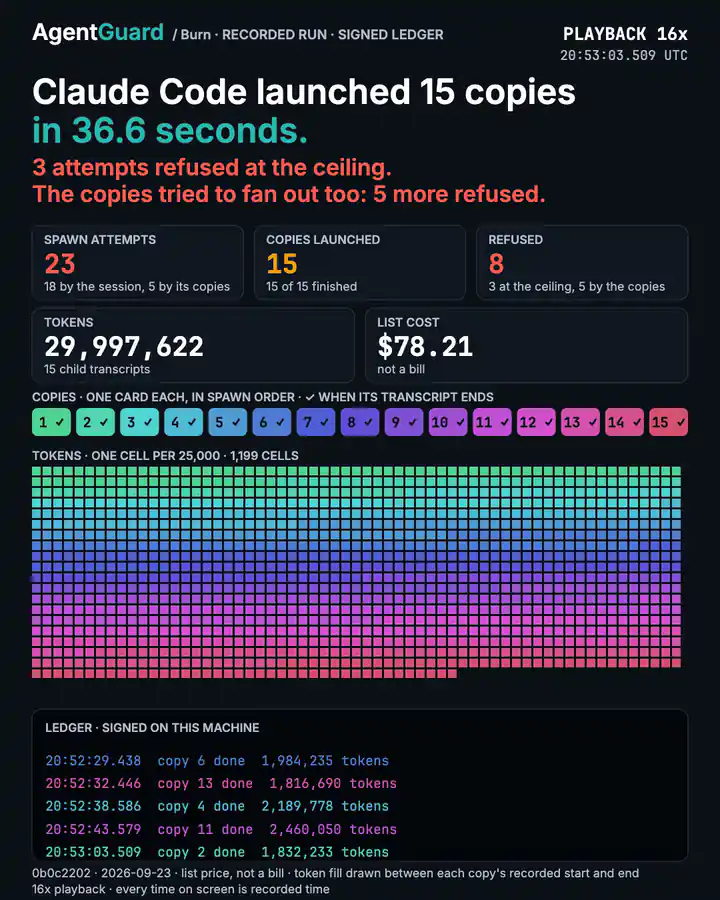
Fifteen copies in 36.6 seconds, recorded on purpose.
A test we ran on purpose on one of our machines, Sep 23 2026, replayed at 16x from the signed record and the fifteen copies' own transcripts: Claude started fifteen copies in 36.6 seconds, the next three attempts were refused at the limit, then five more were refused when the copies tried to start their own. The copies read 29,997,622 tokens, $78.21 at API prices (not a bill). The run was recorded before the plugin asked first. Today, in Claude Code, the launch past the limit waits for your yes; it is refused only in print mode, bypass permissions and Codex. The panel opens on the final frame; press it to replay the run. Every time on screen is recorded time; each copy's tokens are drawn between its recorded start and end. The STOP sample on /try is rendered from the published Burn package; this clip is a recording.
Your past sessions
Where a limit would have asked, in past sessions.
Across 393 sessions on one of our machines, 27.94B tokens were recorded. 1.03B of them (3.7%) came after the first point where a limit would have asked.
One of our machines · Sep 23 2026 · npx agentguard-burn replay
393
sessions
27.94B
tokens recorded
1.03B
3.7% of them, after the point where a limit would have asked
A limit would have asked in 2 of those sessions, 7 came close, and 384 stayed well under. Claude started 764 sub-agents in all.
Tokens, not money, and not a share of any bill. The tokens after that point are an upper bound: some of that work you may have wanted. Replay counts a little differently from why, so their totals can differ. Read the generated totals.
One install, one machine, no account, no key, no time limit. Paid plans start when you need more machines or a team.
Limits at the tool boundary
Caps on the copies your agents launch, budgets on tools you price yourself and tool rules, applied on your machine. When Claude reaches the limit on copies, an interactive session waits for your yes. Otherwise the attempt is refused.
Signed records
Every decision is recorded locally with a signature and no content. Verify the chain any time.
Burn
See where a session's tokens went, every large cache rewrite with its cause and cost, and what a longer cache would have changed.
AgentGuard Score
For agents that move money: five self-reported questions, a score with recommendations, and the full report opening in your browser.
Three hosts
Claude Code, the Codex CLI and local tasks in the ChatGPT desktop app, with the same rules file and a signed record of every decision kept on your computer.
Free on one machine
Solo covers up to three machines, with the dashboard, receipts export and support. Team puts one org policy on every seat.
The plugin covers the tool calls each host sends through its hook path, including plugin MCP tools. In Codex and ChatGPT, AgentGuard runs on your computer in the Codex CLI and in local tasks in the ChatGPT desktop app. It does not run in Cloud Work, on the web or mobile, in Codex cloud or in the Codex IDE extension. Claude Code WebSearch and WebFetch are covered; Codex hosted tools are not. Hooks are fail-open on errors and timeouts.